
weekend inspiration #1 🧠
what i'm reading, listening to and thinking about this week

First of all - thank you so much for subscribing! 🙃
Apart from longer posts, I’d like to use this newsletter to share some great content I find each week.
This year I finally developed a better system for managing and following up on all the interesting stuff that other people create. The trick was to decouple the time of finding the piece from the time when I consume it.
I now instantly move any links I find into a weekly readings page (I use Notion but Pocket is also good) and set aside time on Saturdays to explore them without guilt or time pressure.
This has been working really well, so in this spirit, here’s my weekend dose of inspiration!
📚 Reading
What Self-Awareness Really Is (and How to Cultivate It) - HBR
In this study on 5,000 leaders, researchers identified 2 main types of self-awareness:
internal - how clearly we see our own values, passions, aspirations, fit with our environment, reactions and our impact on others
external - understanding how other people view us on the same factors.
It turns out that people are generally quite unaware about how self-aware they really are and that scoring high on one of them does not necessarily make it easier to score high on the other.
Instead, here are the four combinations that people tend to fall into:
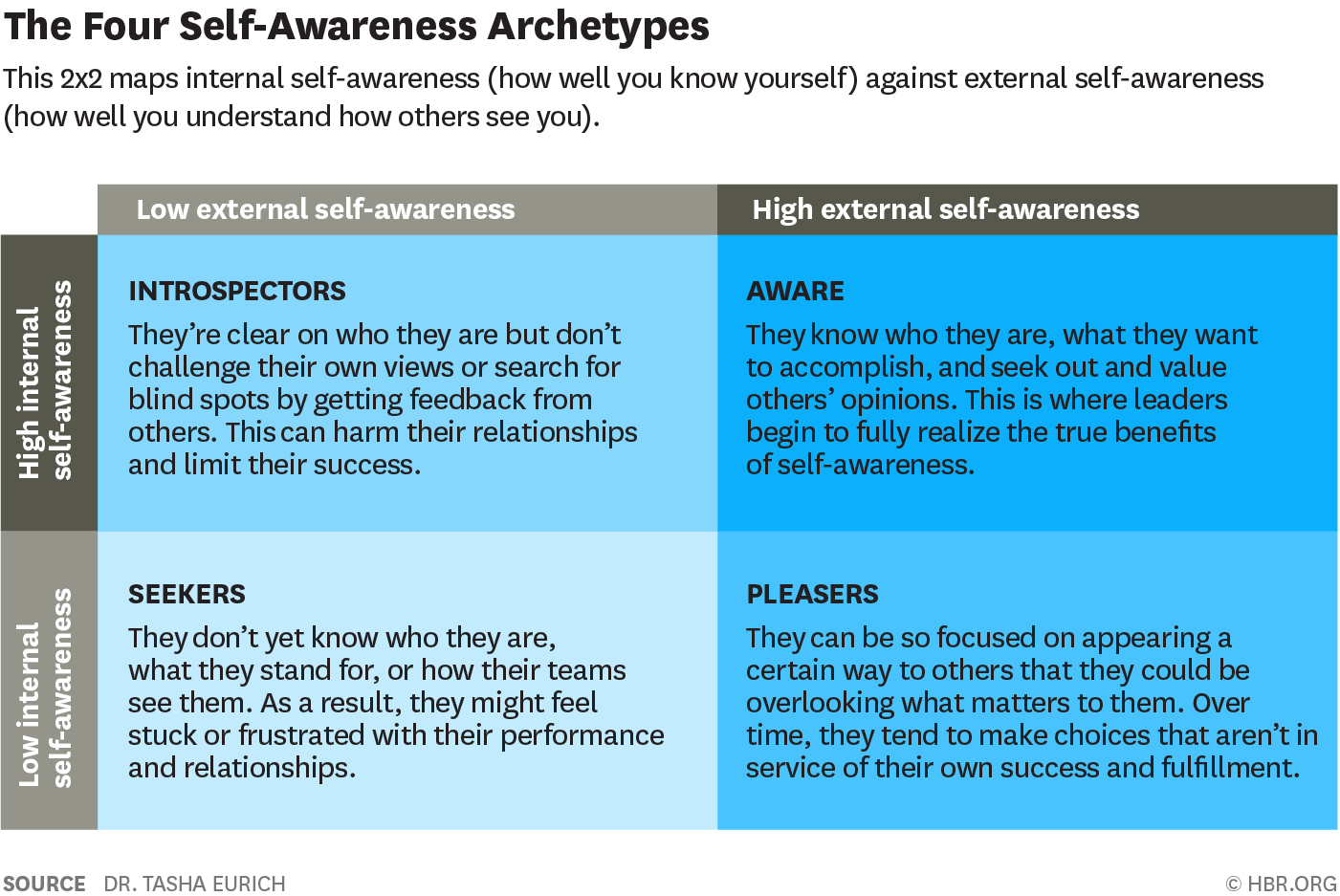
If you’d like to place yourself on these scales, here’s a short online quiz. (Note: you’ll be asked to email someone who knows you well to answer a couple of questions so you can get an external perspective on your self-awareness.)
One interesting observation from the highly self-aware people is that they tend to use “what” questions much more often than “why” questions.
For example, instead of asking themselves:
“Why do I feel so terrible?”
A highly self-aware person will focus on solutions and ask:
“What are the situations that make me feel terrible, and what do they have in common?”
Key takeaway: Focusing on both seeing yourself more clearly and understanding how others see you as well as introspecting about patterns and solutions are all good ways of increasing self-awareness.
Book: Awareness by Anthony de Mello
In the topic of awareness, I need to mention this one.
It’s a short collection of essays covering themes of love, anger, fear, change, suffering, happiness and made a really big impact on me when I was feeling quite lost two years ago.
There is something about the way in which de Mello uses simple questions and metaphors that will challenge you to reflect on your relationship with reality and the forces that try to keep you from engaging fully with life.
It’s energising and snaps you out of the victim mindset within the first couple of chapters.
Here’s one of my favourite quotes:
“How essential it is for the human being not just to observe himself or herself, but to watch all of reality. Are you imprisoned by your concepts? Do you want to break out of your prison? Then look; observe; spend hours observing. Watching what? Anything. The faces of people, the shapes of trees, a bird in flight, a pile of stones, watch the grass grow. Get in touch with things, look at them. Hopefully, you will then break out of these rigid patterns we have all developed, out of what our thoughts and our words have imposed on us. Hopefully, we will see. What will we see? This thing that we choose to call reality, whatever is beyond words and concepts.”
🧘 Relaxing
Embodied Loving-Kindness (mettā) - meditation with Tara Brach (20 min) - listen
As a new lockdown experiment, I’ve been meditating at least 2h/week for the past two months and Loving-Kindness meditation is now my favourite.
If you tried it before, this one gets a bit more into the body than the usual ones which are more focused on affirmations and well-wishing.
I find that mettā practices take some more practice to get it because they ask for a bit more imagination and visualisations than the other types of meditation.
Personally, once I started to try and let go of self-judgments (am I doing it right?) it has been teaching me how to soften up and open up to my emotions in a gentle way.
I now do it for 20 minutes first thing in the morning and it seems to put me in a more relaxed and open-minded state for work and social interactions.
🎧 Listening
IFS, Psychedelic Experiences Without Drugs, and Finding Inner Peace for Our Many Parts (Tim Ferriss Show)
This is probably the podcast I shared the most number of times ever.
I’ve been experimenting with Internal Family Systems (IFS) therapy so I’ve been really excited when Tim Ferriss invited Richard Schwartz, the father of IFS, on his show last month.
IFS is based on the multiplicity theory of the mind where we try to see ourselves as made up of many parts, each with different needs, desires, patterns, personalities, and gifts.
For example, a part of me that is excited about writing this newsletter and the other part that immediately tries to convince me it’s a bad idea and no one will want to read it.
I used to put up a lot with such inner conflict, assuming that’s just the way things are. Turns out it does not have to be.
IFS offers a method for noticing when these parts are at play, when they are not helpful and re-negotiating the roles they play in our life. Parts generally have a good intention for us, but sometimes their ways of getting what they want is not very effective.
The IFS process is focused on tapping into inner compassion, curiosity, calm and confidence to mediate the resolution of the inner conflict - it’s kind of like being a wise parent to two rowdy kids fighting inside of you.
If this sounds a little funny, check out the live session that Richard actually does with Tim around 00:40 in the podcast. It was the first time that a podcast moved me to tears.
Music: Luz by Moullinex